วันอาทิตย์ที่ 5 มกราคม พ.ศ. 2557

เทคนิคการอ่านแบบ Skimming


      Tip and Tricks เคล็ดลับในการอ่านแบบ Skimming

           การอ่านแบบข้าม เป็นการอ่านผ่านเพื่อค้นหาเฉพาะข้อความสำคัญก่อนที่จะ อ่านข้อเขียนนั้นอย่างละเอียด ผู้อ่านจะมองข้อเขียนนั้นโดยรวมว่าเป็นเรื่องเกี่ยวกับอะไร ค้นหาเฉพาะข้อความสำคัญและข้ามส่วนที่คิดว่าเป็นรายละเอียดปลีกย่อยไป ซึ่งจะช่วยให้ได้ข้อสรุปและความคิดเห็นทั่วไปของเรื่องที่จะอ่าน ได้ข้อคิดอย่างกว้าง ๆ ของผู้แต่ง เราใช้วิธีการอ่านแบบนี้เมื่อต้องการหาประเด็นสำคัญภายในเวลาอันรวดเร็ว ในการอ่านแบบข้าม ผู้อ่านจะทราบสิ่งต่อไปนี้ ข้อเขียนนั้นเขียนขึ้นเพื่อใคร เช่น ผู้อ่านทั่วไป หรือผู้เชี่ยวชาญในวิชาชีพ เป็นต้น ข้อเขียนนั้นมีรูปแบบใด เช่น รายงาน จดหมายที่เขียนอย่างเป็นทางการหรือไม่เป็นทางการ บทความ โฆษณา เป็นต้น ผู้เขียนมีวัตถุประสงค์อะไรในการเขียน เช่น เพื่อพรรณนา อธิบายแจ้งข่าวสาร สั่งสอน ชักชวน เป็นต้น เนื้อหาโดยทั่วไปของข้อเขียนเป็นเรื่องเกี่ยวกับอะไร

       สรุป 7 ขั้นตอนของการ Skimming มีดังนี้ คือ :

   1.อ่านหัวเรื่อง 

   2.ดูชื่อผู้แต่ง และหนังสืออ้างอิง

   3.อ่านย่อหน้าแรกอย่างละเอียดและรวดเร็ว เพื่อจับใจความสำคัญของเรื่อง ( main idea )

   4.อ่านหัวเรื่องย่อยและประโยคแรกของย่อหน้าที่เหลือ

   5.อ่านเรื่องทั้งหมดอย่างรวดเร็วเพื่อหา

     -     Main idea, Topic ของทุกย่อหน้าพร้อมทั้ง supporting detail

-          Clue words เช่น ชื่อคน ชื่อวัน และ adjective ที่สำคัญ

-          คำที่แสดงความคิดของผู้แต่ง เช่น เห็นด้วยหรือไม่เห็นด้วย

     -    เครื่องหมายตัวชี้ต่าง ๆ เช่น ตัวพิมพ์เอน ตัวพิมพ์หนา ลูกศร ดาว ฯลฯ

 6. อ่านย่อหน้าสุดท้ายอย่างรวดเร็วและละเอียด

 7. เพ่งเล็งลักษณะตัวพิมพ์พิเศษ เช่น ตัวเอน ตัวหนา ดาว ฯลฯ ให้ดี สำคัญมากเพราะจุดนี้จะบอกให้รู้ถึงการเน้นย้ำใจความสำคัญ


Skimming และ scanning ต่างกันอย่างไร?

      Skimming และ Scanning ต่างเป็นเทคนิคการอ่านเร็วทั้งคู่

           Scanning นั้นจะกวาดสายตาหาเฉพาะสิ่งที่เราต้องการ (a particular thing or person) เท่านั้น เช่น หาคำบางคำ ในสมุดโทรศัพท์เป็นต้น โดยจะไม่อ่านทุกบรรทัดหรือทุกหน้า จะกระโดดจากหน้านี้ไปหน้าโน้นเลย จุดมุ่งหมายอยู่ที่คำบางคำ เท่านั้น ส่ว    

          Skimming นั้นจะกวาดสายตาหาเฉพาะสาระสำคัญที่ต้องการ (a particular point or main points) เท่านั้น 


แบบฝึกหัดการอ่านแบบข้าม (Skimming)

Direction : Skim this passage below and choose the best answers for each question.

                                                              The Taj Mahal

            Often called the most beautiful building in the world, The Taj Mahal stands in the town of Agra in India. It is in fact a tomb built by the emperor Shah Jahan for his wife who died in 1931.

            Visitors to the Taj Mahal enter through a red sandstone gateway which leads into a beautiful walled garden in which a watercourse runs between rows of slender cypress trees. A the end of

the watercourse The Jaj Mahal stands on a marble terrace.

            It’s square building made from pure white marble and topped by a dome. Four slender white minerals or towers rise from the corners of the terrace. Beneath the dome is an eight-sided chamber with a carved marble screen around the tombs of the emperor and his wife.

            The chief architect of the Taj Mahal was Ustad Isa, who may have been a Persian. The building and ornamentation was done by 20,000 men and craftsmen from all parts of Asia. (1632-1650.)


1. Where is the Taj Mahal built?

     a. the town of Emperor          b. the town of Jahan

     c. the town of watercourse   d. the town of Agra


2. Who built the Jaj Mahal?

    a. the Emperor’s wife         b. the Emperor Shah Jahan

    c. the architect                   d. all the above


3. In what year did the Emperor Shah Jahan's beloved wife passed away? 

    a. 1930                                  b. 1931

    c. 1932                                 d. 1933


4. What trees wee grown in the walled garden?

    a. watercourse                b. slender

    c. cypress                         d. white minaret                                                                                


5. What was square building made?

   a. pure white marble  b. pure black marble

    c. crude white steel    d. crude black steel


6. Who was the chief architect of the Taj Mahal?

    a. Prince Persia            b. Ustad Isa

    c. Shah Jaha                 d. Andy Wilson


7. According to the passage, what nationality did Ustad Isa have?

    a. Croatian    b. Chinese

    c. Caucasian d. Persian        


8. How long had the Taj Mahal been built?

    a. ten years                     b. fifteen years

    c. seventeen years           d. eighteen years


Grammar : Simple Present Tense


Present Simple Tense
 
                      โครงสร้างประโยค  คือ   Subject + Verb 1
        
          ใช้กับเหตุการณ์
1. ใช้กับเหตุการณ์หรือการกระทำที่เป็นความจริงตลอดไปหรือเป็นความจริงตามธรรมชาติ เช่น
The sun rises in the east.( พระอาทิตย์ขึ้นทางทิศตะวันออก )            .                                            
  Fire is hot.
( ไฟร้อน )
             2. ใช้กับการกระทำที่ทำจนเป็นนิสัย มักจะมีกลุ่มคำที่มีความหมายว่า เสมอๆ บ่อยๆ ทุกๆ อยู่ด้วย เช่น             
I get up at six o’clock everyday.
( ฉันตื่นนอนเวลา 6 นาฬิกาทุกวัน )                                                                           
หลักการจำและนำไปใช้
             1.  ประธาน  He, She, It  หรือ 1 เดียวเท่านั้น ต้องเติม s หรือ es  ท้ายคำกริยาด้วย มีกริยาช่วย คือ does 
                2.  ประธาน I, You, We, They, หรือ 2 ขึ้นไป กริยาเหมือนเดิม มีกริยาช่วย คือ  do
   3.  do และ does  ใช้ในประโยค คำถามและปฏิเสธ
   4.  ในประโยคมีคือ does กริยาไม่ต้องเติม s / es
 
ชนิดของประโยค
    1. ประโยคบอกเล่า =   Subject + Verb1 + (Object).   เช่น
 
                 She likes English .
                 Jack plays football everyday.
                 I like Thai .   
                 Jack and his friends play football everyday.
 
     2. ประโยคคำถาม
         2.1  Yes/No question
               ใช้  Do, Does + ประธาน + กริยา ?  
 
                 Does she like English? 
               Does Jack play football everyday?                 
                 Do you like Thai?
                 Do Jack and his friends play football everyday?
 
            การตอบแบบ Short answer  
               Yes, he/she/it does.
                 No, he/she/it doesn’t.
 
                 Yes, I/you/we/they do.
                 No, I/you/we/they don’t.
        
2.2   ใช้ Question words 
       (What/ Where/ When / Why/ ……+ do/does + ประธาน + กริยา…….?) เช่น
          
           What do you eat for lunch?       I eat noodles.
                      Where does Jim go Mondays?   He goes to school. 
                                   How do they go to school?         They go to school by school bus.
 
 
     3. ประโยคปฏิเสธ ใช้ do not (don’t), does not (doesn’t) ตามด้วยคำกริยาแท้รูปเดิม           I don’t like Thai.                                                                                                                                                                                                  
         She
doesn’t like English.                                                                             
         Jack
doesn’t play football everyday.         
                                                                                   
หลักการเติม s ที่คำกริยา
1.กริยาที่ลงท้ายด้วย o, s, x, ch, ss, และ sh,  ให้เติม es เช่น
        pass - passes = ผ่าน        brush - brushes = แปรงฟัน    catch - catches = จับ                           
go - goes =
ไป               
box - boxes =
ชก
2.กริยาที่ลงท้ายด้วย y และหน้า y ไม่ใช่  a e i o u ให้เปลี่ยน y เป็น i แล้วเติม es
       study studies เรียน,          cry - cries = ร้องไห้,         fry - fries = ทอด    
3. กริยาที่นอกเหนือจากที่ไม่เข้ากฎในข้อ 1 และ ข้อ 2 ให้เติม s ได้เลย
 
Adverb of Frequency  ใช้ขยายคำกริยา เพื่อบอกถึงความถี่ของการกระทำ และจะวางไว้หน้าคำกริยานั้นๆด้วย ยกเว้น sometimes อยู่ ต้นประโยคก็ได้ เช่น
                 always    สม่ำเสมอ 100 %           usually    เป็นประจำ 80 %     often       บ่อยๆ 60 %
           sometimes    บางครั้งบางคราว 30 %   seldom    นานๆครั้ง 10 %       never     ไม่เคย 0 %
 
Examples:
      Sandy always goes to school early.
      Mary usually cooks dinner.
      We often drink milk.
      I never go to London.
                         Sometimes I eat pizza for lunch.
  
 
Present Simple Tense
Choose the correct answer.
  1. She ___ four languages.
    a. speak
    b. speaks

     
  2. Jane is a teacher. She ___ French.
    a. teach
    b. teaches

     
  3. When the kettle ___, will you make some tea?
    a. boil
    b. boils

     
  4. I always ___ the window at night because it is cold.
    a. close
    b. closes

     
  5. Those shoes ___ too much.
    a. cost
    b. costs

     
  6. The food in Japan is expensive. It ___ a lot to live there.
    a. cost
    b. costs

     
  7. His job is great because he ___ a lot of people.
    a. meet
    b. meets

     
  8. He always ___ his car on Sundays.
    a. wash
    b. washes

     
  9. My watch is broken and it ___ to be fixed again.
    a. need
    b. needs

     
  10. I ___ to watch movies.
    a. love
    b. loves

     
  11. I ___ to the cinema at least once a week.
    a. go
    b. goes

     
  12. They never ___ tea in the morning.
    a. drink
    b. drinks

     
  13. We both ___ to the radio in the morning.
    a. listen
    b. listens

     
  14. He ___ a big wedding.
    a. want
    b. wants

     
  15. George ___ too much so he's getting fat.
    a. eat
    b. eats

     
  16. The earth ___ round the sun, doesn't it?
    a. go
    b. goes

     
  17. The shops in England ___ at 9:00 in the morning.
    a. open
    b. opens

     
  18. The post office ___ at 5:30 pm.
    a. close
    b. closes

     
  19. Jackie ___ two children now.
    a. has
    b. have

     
  20. Mr. Smith ___ too much. He always has a cigarette in his mouth.
    a. smoke
    b. smokes

     
  21. When the phone ___, please answer it.
    a. ring
    b. rings

การบอกเวลา

>> Telling the time บอกเวลาเป็นภาษาอังกฤษ

 
What’s the time?  /  What time is it ? ประโยคคำถามพื้นฐานที่อาจทำให้หลายๆคนอาจงงกันได้ เพราะนึกคำตอบไม่ออก
 
   สำหรับการถามเวลาเราสามารถพููดว่า :
       1. What’s the time?
       2. What time is it?
       3. Do you have the time?
       4. Have you got the time?
       5. What time do you make it?


วิธีหลักๆในการบอกเวลาจะแบ่งเป็น 2 แบบ
      แบบแรก คือ British English – ใช้ระบบเวลาแบบ 12 ชั่วโมง (12-hour clock) 
โดยจะใช้เลข 1 ถึง 12 ตามด้วย a.m. และ p.m. 
            a.m.  =  ante meridiem  =  หลังเที่ยงคืน ถึง ก่อนเที่ยงวัน   ( 00.01 a.m. – 11.59 a.m. )
            p.m.  =  post meridiem  =  หลังเที่ยงวัน  ถึง ก่อนเที่ยงคืน   ( 12.00 p.m. – 11.59 p.m. )
  • เวลาเต็มชั่วโมง – ให้เติมคำว่า “o’clock” ท้ายเวลา อาจเติมคำบอกเวลาหรือพูด “เอ-เอ็ม” และ “พี-เอ็ม” เพื่อให้สามารถเข้าใจได้ง่ายขึ้น เช่น 
     10.00 a.m. = ten o’clock in the morning / ten a.m. (เท็น-เอ-เอ็ม)
     04.00 p.m. = four o’clock in the afternoon / four p.m. (โฟร์-พี-เอ็ม)
               **สำหรับเวลาเที่ยงวันให้ใช้ noon และเที่ยงคืนให้ใช้ midnight
  • เวลาที่ผ่านชั่วโมงมาแล้ว แต่ไม่เกิน 30 นาที – ให้บอกนาทีนำหน้าตามด้วย “past” และชั่วโมงที่ผ่านมา เช่น
      09.25 a.m.  =  twenty-five past nine
      05.12 p.m.  =  twelve past five
  • เวลาที่ผ่านชั่วโมง และเกิน 30 นาทีมาแล้ว – ให้บอกนาทีที่เหลือก่อนจะถึงชั่วโมงถัดไป ตามด้วย “to”  และชั่วโมงถัดไป เช่น
      07.50 a.m.  =  ten to eight
      08.40 p.m.  twenty to nine
อย่าลืม หากนาฬิกาเป็นเวลา 15 นาทีหรือ 45 นาที ให้ใช้คำว่า a quarter และ หากเป็น 30 นาที
 ให้ใช้ half เช่น
             06.15 a.m.  =  a quarter past six
             06.30 a.m.  =  half past six
             06.45 a.m.  =  a quarter to seven
 
 
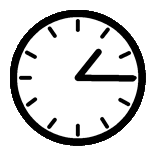
clocktime


       แบบที่สอง คือ American English – ใช้ระบบเวลาแบบ 24 ชั่วโมง (24-hour clock)
ใช้ตั้งแต่เลข 0 ไปจนถึง 24 เลยครับ ไม่มี a.m. และ p.m. 
           วิธีพูด คือ บอกเลขชั่วโมงก่อนตามด้วยเลขนาที มักจะใช้ในทางทหารหรืองานที่เป็นทางการหเพื่อไม่ให้สับสน เช่น
      20.15   =   twenty fifteen
     08.05*  =   eight O five (เอท-โอ-ไฟฟ์)  *ใช้เสียง O (โอ) แทนเลขศูนย์ครับ
     17.50    =   seventeen fifty
เทคนิคเล็กน้อย: การบอกเวลาสามารถเติมคำประมาณได้ด้วยนะ อย่าง about, around หรือ nearly เช่น
             08.02  =   It’s about eight o’clock
             09.27  =   It’s nearly half past nine

       แต่จริงๆแล้วต้องดูผู้ฟังด้วยนะว่าเข้าใจการบอกเวลาแบบไหน สมมติเวลา 7 โมงเช้า  50 นาที ถ้าเราบอกว่า “ten to eight ” ให้กับคนอเมริกันฟังอาจสับสนได้ จึงควรเปลี่ยนเป็น “seven fifty” แทน 


Exercise
 

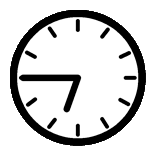
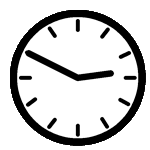
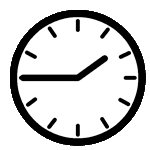
1. What time is it? Choose the right answer.


It's half past eleven.
It's eleven o'clock.
It's twelve o'clock.


It's a quarter past six.
It's half past three.
It's a quarter to six.


It's five past three.
It's five past four.
It's five to four.

It's half past four.
It's four o'clock.
It's half past five.


It's ten past eleven.
It's ten to twelve.
It's ten past twelve.


It's twenty to nine.
It's nine to twenty.
It's twenty past eight.
It's four past ten.
It's ten to four.
It's ten past four.


It's a quarter to five.
It's a quarter past five.
It's a quarter past four.


It's half past two.
It's twenty-five to two.
It's twenty-five past two.

It's four to five.
It's five past four.
It's five to five.


It's twenty-five to five.
It's twenty-five past four.
It's twenty-five to four.


It's sixty past two.
It's sixty to four.
It's three o'clock.


2. What time is it? Write the answer.


It's


It's

It's


It's
 
It's


It's

It's  


It's
 
It's  


It's
 
It's  


It's
 
It's  


It's
 
It's


It's